After promptly dispatching his side’s second goal against Huddersfield from the penalty spot, Luka Milivojevic pointed towards the travelling Palace fans before sliding to his knees and taking the acclaim of his congregating teammates.
Behind him, Andros Townsend and Wilfried Zaha ran to congratulate one another, keen to acknowledge the role that they had both played in doubling Palace’s lead.
For his part, Zaha had picked the ball up just outside the Palace penalty area before dancing away from Jonathan Hogg and playing a neat one-two with James McArthur. Having manufactured a three-on-three counter attack, he then proceeded to play in Townsend, who went on to draw a foul from Mathias Jørgensen and win Palace a penalty.
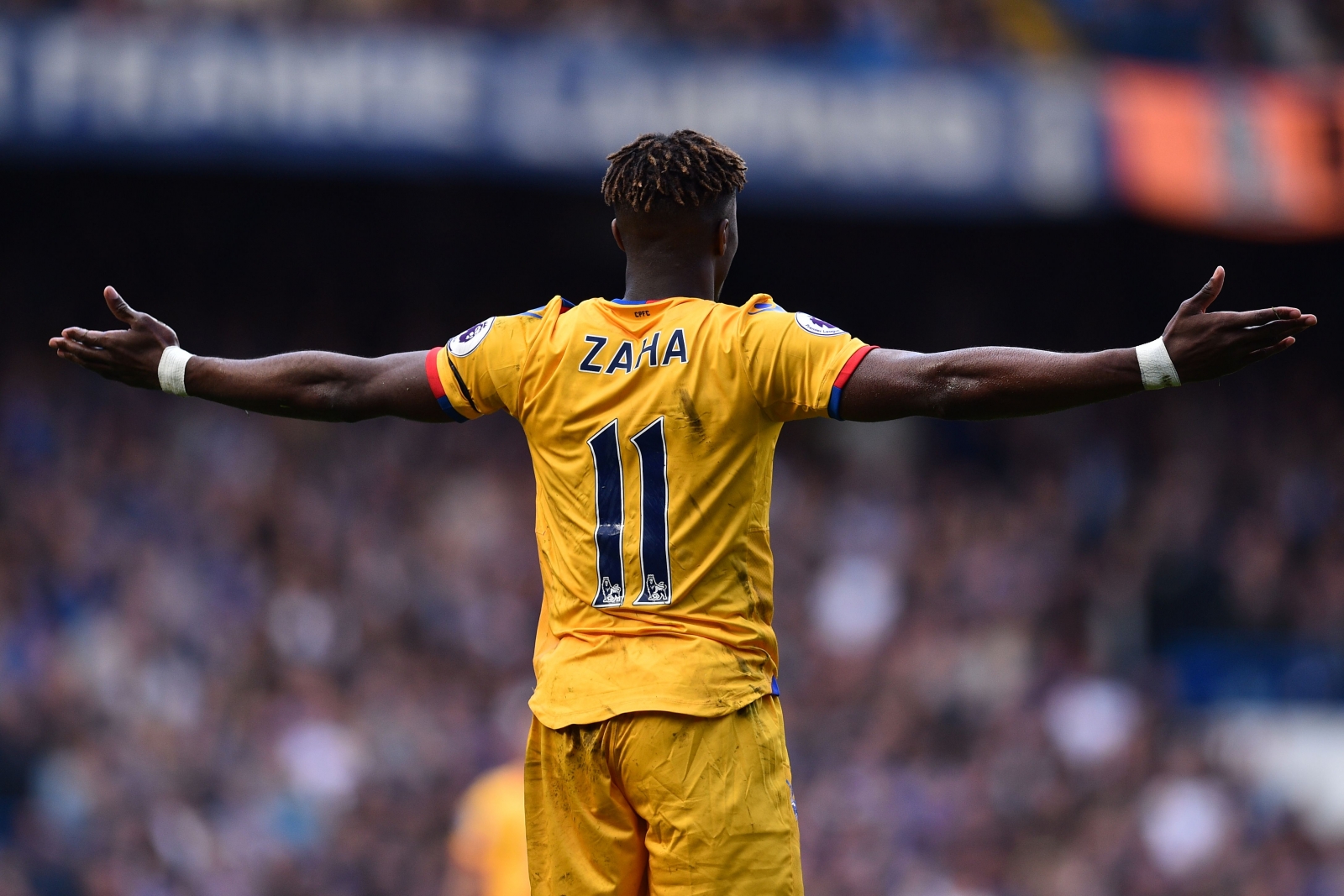
Indeed, Zaha might not have had a direct hand in either goal, but his contribution was far more than a helping one. In the games the 25-year-old missed through injury – against Everton, Tottenham and Manchester United – Palace managed a total of thirteen corners across those 270 minutes. Against Huddersfield, the Eagles amassed more than half that figure, and the majority of those were earned by Zaha, including the one that led to James Tomkins’ opening goal.
When news first broke back in February that Zaha was going to miss a number of games with injury, it was bemoaned by Palace fans with the same vigour as it was celebrated by supporters of the Eagles’ relegation rivals. It is no secret that Zaha is pivotal to Palace’s survival hopes, and it didn’t take long for Twitter to remind us that the Eagles had lost every game without their star man this season, and that they hadn’t won in his absence since September 2016.
Stats can be misleading – a similar one used to surface about Jason Puncheon whenever he was omitted from the Palace line up – but there can be no doubting that the Eagles become easier to play against when Zaha is missing. The performances against Everton, Spurs and United – and the first half against Chelsea – didn’t lack fight, but were more rigid and unimaginative, and ultimately yielded zero points. It was a run of form which saw Palace slide back down the table, and one that naturally led to allegations of the Eagles being a one-man band.
The term ‘one-man team’ is generally levelled at a club in a derogatory sense. In essence, it accuses a team of being overly reliant on one of their players while rendering the others incapable of winning without him. Ironically, though, a one-man team tends to be one that is succeeding, and can only do so if that one player enables the ten around him to flourish.
Harry Kane, for example, brings the best out of Christian Eriksen and Dele Alli at Tottenham, while Pascal Gross is the man who has made his teammates tick over at Brighton. In the same way, Chelsea are an infinitely better outfit when Eden Hazard is on form, while Leicester have been the beneficiaries of Riyad Mahrez’s meteoric rise since he joined them in the Championship.
In other words, every team is in some way reliant on their star player, and Palace are no different. When Zaha was brought on for the second half against Chelsea, the home side retreated a step or two, and the Eagles started playing as if the Ivorian’s return had brought with it a renewed sense of belief. The likes of James Tomkins and Luka Milivojevic have also been outstanding this season, but football primarily deals in the currency of scoring goals, and there is no-one who plays a bigger part in that for Palace than Zaha.
Even when he’s not at his best – or even not fully fit, as may have been the case against Huddersfield – Zaha’s mere presence is enough to occupy opposition defenders, consequently affording his supporting midfielders an extra moment on the ball. For those midfielders, to look up and see Zaha comes with the assurance that a forward pass won’t be a wasted one, while his ability to carry the ball from one end of the pitch to the other allows the back four to catch their breath, rather than look up to see another wave of attack crashing towards them.
Put simply, Zaha’s influence spreads wider than the pocket of pitch in which he operates. Against Huddersfield, Christian Benteke looked more motivated knowing he had Zaha’s company alongside him, while his ability to push the Terriers deeper allowed McArthur, Milivojevic and Yohan Cabaye to control the game in ways that Palace’s midfield hasn’t been able to in recent weeks. It was indicative of the spark that Palace have been lacking, and embodied the way in which Zaha is capable of extracting a higher level of performance out of his teammates.
If Palace have become a one-man team, then, it is only because they have been tailored to enable their talisman to have the biggest say on the outcome of any game. And if being a one-man band is seen as a bad thing, then Palace ought to revel in their sin, because Zaha’s presence not only has a revitalising effect on his teammates; it has a transformative one on the team’s results as well.


1 comment
I felt all the returnees played a part. Cabaye has also been much missed and to see him pouring through Huddersfield shattered midfield late on and narrowly missing with at least a couple of shots was another reminder of what we’d been missing. Our ability to dictate terms. We also lost very narrowly to Man U, Spurs and Chelsea with “weakened” sides, Critixcs should try taking ten plaers out of any squad and try playing those 3. Zaha certainly adds hugely but it unfair to call him the be all and end all, good as he is
Comments are closed.