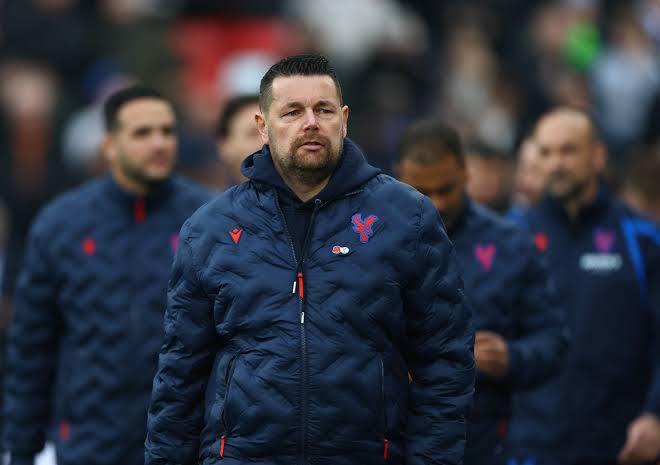
The dreaded November international break has arrived for Pierre Sage, and he will know that this is a period when under-pressure managers are typically under the cosh.
With 10 Premier League games already played this season, many see this as a fair point to reflect on the campaign so far and make judgements. Unfortunately for Sage, there will be some harsh judgements from Palace fans after the Eagles crashed to the bottom of the table following a 3-1 home defeat to Liverpool, despite playing some good football, particularly in the first half.
However, good football is not counting for very much right now, as Palace made it four league defeats in a row against the Merseyside club. The main reason for frustration is not the intricate football the team has been playing, nor even their inability to score goals. Instead, it is the repetition of the same old mistakes.
Palace are not learning from their deficiencies, and their inability to deal with set pieces and quick transitions is being heavily punished. Against Newcastle, it was Will Osula and Harvey Barnes who profited. Against Tottenham, it was Archie Gray and Jan Paul van Hecke. Against Liverpool, it was the trio of Alexis Mac Allister, Florian Wirtz and Alexander Isak.
Once again, Palace played some encouraging football and arguably should have been ahead at the break. Yeremy Pino cannoned an effort against the crossbar before Oscar Mingueza went close with a volley at the back post that was expertly saved by Alisson. Jorgen Strand Larsen then thought he had given Palace the lead as he coolly dinked the ball over the Brazilian goalkeeper, but the Norwegian’s effort was ruled out for offside.
Nonetheless, Palace looked far more confident on the ball, with Adam Wharton and Quinten Timber finding pockets of space, while full-back Mingueza stood out for both his attacking forays and defensive balance.
However, all of this good work was about to be undone by the most basic of goals. Palace had already been given a warning when Dominik Szoboszlai picked out a completely free Bradley Barcola at the back post, only for the winger to spoon his effort over the bar. Yet moments later, Jefferson Lerma fouled the Hungarian in a similar position, and the resulting delivery was met at the near post by Mac Allister, who wheeled away in celebration.
It was simply too easy.
All the positivity generated by an impressive first-half display disappeared due to one hopeless piece of defending from a cross.
The flick beat Dean Henderson, who could do nothing about the goal. The moment seemed to happen in slow motion, and Palace had no answer. The second half brought another goal that appeared to be a carbon copy of many conceded previously, particularly Harvey Barnes’ strike on 25 October.
Ronald Araujo played a routine pass down the right flank, which Barcola latched onto. He then found Wirtz unmarked in the box, and the German finished without fuss. The third goal, scored by Isak, was more of the same, as Palace had pushed up the pitch in search of inspiration that never arrived.
The questions can therefore be directed towards the manager. Why is this happening so regularly? Why are Palace conceding the same type of goal over and over again?
The more important question, however, is whether the fault truly lies with Sage. Is he setting up the team to be defensively vulnerable, or is it simply the cold reality that the current personnel are not good enough? The answer probably lies somewhere in the middle.
When it comes to set pieces, I am of the belief that responsibility falls largely on the players. They should be stepping up to meet crosses and deliveries into the box themselves, something Sage cannot physically do for them. The fact that someone as small as Mac Allister was able to win near-post headers twice tells you everything you need to know. Van Hecke even scored one for Tottenham while sitting down, and that is no exaggeration.
The issues at the front post are nothing compared to the problems at the back post. That is how Archie Gray scored against Palace on Halloween, and quite how Nottingham Forest failed to punish Palace from a similar situation at Selhurst Park last month remains a mystery.
The players must organise themselves better, ensure opponents are properly marked and track runners into dangerous areas. These are the basics of defending set pieces, and they are aspects of the game that professional footballers should already understand.
Dean Henderson’s return has not yet resulted in greater defensive stability, although the 1-0 Carabao Cup victory away at Fulham should serve as a blueprint for how Palace should defend.
The vulnerability to counter-attacks, however, is an issue that Sage can address. Teams are winning back possession and, with a single pass, bypassing Palace’s midfield before exposing dangerous spaces out wide.
This open space on the flanks is largely a consequence of the system and the fact that Palace’s wing-backs are often caught too high up the pitch. By the time they recover their positions, the ball has already been worked into a dangerous area. Wirtz was the beneficiary on this occasion.
If Sage were to switch to a back four, I believe this Palace side would enjoy greater success. The reason the 3-4-2-1 worked so effectively under Oliver Glasner was primarily because of the quality of the back three.
With Marc Guehi and Maxence Lacroix no longer at the club, Palace are placing weaker defenders in vulnerable situations, without the additional support that comes with a more traditional defensive structure.
So, is it Sage’s fault that he does not have defenders of the quality Glasner had at his disposal?
That could be attributed to shortcomings in the boardroom, where sufficient replacements were not recruited. Much has already been said about the limitations of certain signings, whether it be Axel Disasi’s tendency for an error, Honest Ahanor’s inexperience, or Takehiro Tomiyasu’s injury record.
Either way, Guehi and Lacroix were not adequately replaced, and that was always going to be difficult given their quality and Palace’s financial limitations. Steve Parish and his recruitment team perhaps should have moved earlier, identifying potential successors before the summer and anticipating the departures of key figures such as Lacroix and Glasner.
Another significant departure that has hurt Palace defensively is Daniel Munoz’s move to Nottingham Forest. Anan Khalaili has struggled to reach the required level, although his long-term potential remains high. Oscar Mingueza impressed against Liverpool and may eventually fill the void left by the Colombian, but his absence is clearly being felt.
Perhaps the transition from a Conference League-winning side has simply happened too quickly, and that is largely out of Sage’s hands.
However, there is also a strong argument that he should be getting more from the players currently available to him and that a tactical adjustment would benefit the team. He appears to favour a midfield pairing of Adam Wharton and Quinten Timber, yet at times it feels as though the two talented midfielders are getting in each other’s way and drifting too high up the pitch together, leaving dangerous spaces in front of the defence.
Wharton has often looked more comfortable alongside Daichi Kamada, while introducing Will Hughes more frequently could provide greater protection and a stronger platform from which Wharton can influence games. In previous seasons, Wharton was able to dictate matches without constantly worrying that one misplaced pass would expose the team behind him.
That should not entirely excuse the midfielder, however, as his own performances have dipped compared to the standards he previously set.
For now, though, the debate is largely out of Sage’s hands. It is entirely possible that both his fate and his position as Palace manager will be decided in the coming days.
Thomas Frank has recently emerged as a leading candidate for the role, and while his appointment could provide a valuable new-manager bounce ahead of important fixtures against Coventry and Hull, it remains difficult to know whether any manager could fully overcome the consequences of a difficult summer recruitment window.
What is easier to argue is that Sage himself has not done enough to convince supporters that he is the man to lead the club forward.
Time will tell, but right now a decision needs to be made, and quickly.


